We tested 10 of the most popular travel strollers head to head to crown the best travel stroller: the Joolz Aer 2, UPPAbaby MINU V3, MamaZing Ultra Air X, Colugo Compact+, Stokke YOYO 3, Bugaboo Butterfly 2, Ergobaby Metro 3, the Summer Infant 3D Lite, the GB Pockit and the Baby Jogger City Tour 2.
The wrong travel stroller turns a smooth boarding process into a nightmare. You’re blocking the jet bridge, fumbling with a fold that won’t fold, your kid’s screaming, snacks are pulverized into the carpet, and thirty passengers are watching you question every decision that led to this moment. That’s just you — your kid’s having an even worse time.
We’ve been there. So my son Hank and I (now 2, with a brand-new baby brother), spent seven months and over $3,000 testing ten of the most popular travel strollers on the market. Six airports. Five road trips. Approximately eighteen trips to the zoo to visit LuLu the rhinoceros, who, for the record, could not care less about our stroller drama.

The original version of this post was published in 2025 with seven strollers tested by me and Fathercraft contributor Kristan. For 2026, we expanded the lineup, retested everything, and made some big changes to our picks. Two popular strollers we previously recommended? They’re in our disasters category now, after expanded testing. More on that below.
Four of these strollers earned a spot in your trunk. The other six? One of them almost ended up in a dumpster.
Heads up: Fathercraft is reader supported, meaning, at no cost to you, we may earn a commission if you click a link and make a purchase. Details in our policies.
After 7 months and $3,000 testing 10 strollers across 6 airports, four made the cut. Jump to the one that fits you:
- 🏆 Best overall / best for flying → Joolz Aer 2 ($579)
- 💎 Best ride quality / Europe / long walking days → UPPAbaby MINU V3 ($499)
- 💰 Best budget (6 months+) → MamaZing Ultra Air X ($200–$250)
- 💰 Budget runner-up / auto-fold → Colugo Compact+ ($199)
- ❌ Strollers we’d skip at any price → See the disasters
Our best overall travel stroller winner
The Joolz Aer 2 ($579, 14.3 lbs) is the best travel stroller for flying we’ve ever tested — one-handed fold in under two seconds, packs to about nine inches thick when folded, and accepts car seat adapters from birth. I have tested 16 travel strollers. This is the one I fly with every time.

Folds like a dream. Lightweight. Well-designed. All this makes the Aer 2 our overall top travel stroller pick.
Full reviews, scoring data, and the strollers that nearly made me throw them into a dumpster — keep reading.
How the travel strollers we tested stack up
Swipe sideways for all 10 →
| Feature | Joolz Aer 2 | UPPAbaby MINU V3 | MamaZing Ultra Air X | Colugo Compact+ | Stokke YOYO 3 | Bugaboo Butterfly 2 | Ergobaby Metro 3 | Summer Infant 3D Lite | GB Pockit | City Tour 2 |
|---|---|---|---|---|---|---|---|---|---|---|
| Our Verdict | ✅ Best Overall | ✅ Premium Pick | ✅ Best Budget | ✅ Budget 4 mo+ | ❌ Avoid | ❌ Avoid | ❌ Avoid | ❌ Avoid | ❌ Avoid | ❌ Avoid |
| Approx Price | $579 | $499 | $249 | $199 | $499 | $599 | $299 | $89 | $270 | $359 |
| Weight | 14.3 lbs | 16.7 lbs | 9.9 lbs | 16.2 lbs | 14 lbs | 16.1 lbs | 16.7 lbs | 13 lbs | ~10.5 lbs | ~14 lbs |
| One-Hand Fold | 10/10 | 8/10 | 7/10 | 8.5/10 | 3/10 | 7/10 | 3/10 | 2/10 | 2/10 | 3/10 |
| Smooth Ride | 👍 | 🌟 | 👍 | 👍 | 👍 | 👍 | 👍 | ❌ | ❌ | 👍 |
| Carry-On? | Yes | Yes | Yes | Yes | Yes | Yes | Check airline | Yes | Fits under seat | Yes |
| Storage | 5/10 | 9/10 | 4/10 | 6/10 | 3/10 | 8/10 | 7/10 | 4/10 | 2/10 | 4/10 |
| Harness | 👍 | 👍 | 👍 | 👍 | 👎 | 👎 | 👎 | 👎 | 👎 | 👎 |
| Car seat adapter | Yes | Yes | No | No | Yes | Yes | Yes | No | No | No |
Our testing process
We scored each stroller across eight categories: fold, portability, ride quality, weight, parent ergonomics, storage, durability, and cost. Selected scores are in the table above; the reviews below explain the tradeoffs.
This review started in 2025, when Kristan and I tested seven travel strollers across airport runs, neighborhood walks, and daily errands with real kids in tow. For 2026, I expanded the test to 10 strollers over seven months. The testing covered six airports, five road trips, and more zoo visits than any adult should willingly endure. Between both rounds, we folded and unfolded these strollers hundreds of times, worked through TSA lines, fit them into overhead bins, and pushed them one-handed across gravel while holding a drink carrier.
I tested for what actually matters when you’re traveling with small kids: can you fold it fast at the jet bridge? Can you steer it one-handed? Will it survive being checked by airline baggage handlers who treat your gear like a shot put? And does your kid actually want to sit in it, or are they going to fight you at every boarding call?
- Looking for full-sized strollers? Read about our top 2026 picks here.
Is a travel stroller worth it?
If you’re looking at these prices, you might be asking yourself if a travel stroller is worth it at all. Can’t you just use your full-size stroller for travel?
If you’re traveling with small kids (4ish or under), the answer is a resounding yes—you need a travel stroller. Ok, need might be strong… parents survived for millennia without them. But you’re going to be really, really sorry you don’t have one if you don’t get one and you’re the type of person who likes to leave the house. You’re going to need to move your kids around, just like at home, but your full-sized Mockingbird setup (our Mockingbird review here) isn’t going to fit on a plane.
And if you’re thinking about grabbing that $20 umbrella stroller at Costco instead… we tested the Summer Infant 3D Lite as a low-cost comparison, and it’s in our disaster tier for a reason. Two separate handles (no one-handed steering), a frame that compresses into a metal yardstick instead of folding compactly, and materials that feel like a cheap Halloween costume. The $80-$200 you save upfront costs you in frustration every single time you use it.

Tier 1: Premium travel strollers ($500–$600)
If you have $500 or so to spend on a travel stroller, you’d be nuts to choose anything other than one of these two. Both are excellent. Both will serve you well for years. The question is which one matches your priorities.
Joolz Aer 2: Best overall travel stroller ($579)
Weight: 14.3 lbs | Fold score: 10/10 | Portability: 9/10
Choose this if portability is your top priority.
There are sixteen travel strollers in my garage right now. This is the one I fly with. Every time.
The Joolz Aer 2 has the best fold of any stroller we’ve ever tested. One-handed. Instant. No wrestling with fabric, no interpretive dance with levers. I can collapse this thing in under two seconds while holding Hank. (I made my wife time it. She loved that.)
Joolz lists the Aer 2 folded at 20.9 × 17.3 × 9.2 inches (length × width × height). The compact fold makes it easier to pack for travel — check your airline before planning on cabin storage. At the jet bridge, Hank only needs to be out of it for maybe fifteen seconds while I fold and bag it. Otherwise he stays strapped in and contained, which is exactly what you want when boarding a plane full of people who are absolutely judging you.
What’s new in the Aer 2: This is the upgraded version of the Aer+, which was our top pick in 2025. Joolz made some real improvements: taller frame, larger wheels, a bigger basket, an adjustable footrest, and a better harness. Not flashy upgrades. Functional ones.
The downsides: The recline is annoying. Joolz lists three positions, but after you unzip the back you only get about a one-inch drop into a one-sided hook that feels wobbly — not a real middle setting. Unclip the hook and it does go flat. Fine for lie-flat; useless if you wanted a stable mid recline. The basket, while improved over the Aer+, is still on the small side. And the single-pedal brake will haunt you if you live in sandals.
Best for: Frequent flyers. Airport warriors. Anyone who values a fast, reliable fold above everything else.
What we loved: One-handed fold so smooth it feels like magic. Tight construction. Small footprint makes it a true compact travel stroller. Just works.
“Holy crap” moment: I could shut this thing down with a baby in one arm and a coffee in the other.”
Downsides: Modest storage basket. Premium price.
Folds like a dream. Lightweight. Well-designed. All this makes the Aer 2 our overall top travel stroller pick.
UPPAbaby MINU V3: Best premium ride ($499)
Weight: 16.7 lbs | Ride quality: 9/10 | Storage: 9/10
Choose this if you prioritize ride quality, storage, and all-day comfort.
The MINU V3 is not the lightest stroller in this test. It’s not the most compact. But it is the Rolls-Royce of travel strollers. Nothing else in this lineup feels this good to push.
The ride quality is the best we tested. The shocks smooth out rough sidewalks like they’re freshly paved airport runways. This is the stroller I reach for whenever we’re off any kind of paved surface — including at the park, where following a two-year-old means leaving the path and going wherever Hank decides to go. The suspension handles it. Most travel strollers in this price range don’t.
The materials are a cut above everything else here. The fabric is plush. The handlebar is wrapped in leather that feels like it belongs on a BMW, not a device covered in Cheerio dust and mysterious sticky substances. The recline is the best in the group: smooth, deep, and easy to adjust with no zippers.
And the basket is massive — 9/10, the best in this test. Full diaper bag, snacks, three jackets your kid won’t wear, and the emotional support water bottle you need to survive the outing. It all fits. The Joolz scores a 5/10 on storage, which is its clearest weakness.

These are the two best travel strollers in this test, and which one you pick depends entirely on what kind of trip you’re taking. Think of the Joolz as the airport specialist and the MINU as the ground game. The Joolz is lighter (14.3 vs 16.7 lbs), folds faster (10/10 vs 8/10), and packs down to about nine inches thick. If most of your travel means planes, jet bridges, and overhead bins, that’s your stroller. The MINU wins when you’re on the ground for hours: cobblestone streets, long city walks, anywhere the terrain is rough and the day is long. The gap between a 9/10 and a 7/10 ride quality doesn’t sound like much until you’re two hours into pushing across uneven pavement.
The downsides: It’s heavier. You feel those extra two and a half pounds after hauling it through the airport while also carrying your kid, three bags, and the tattered remnants of your dignity. Carry strap is weird. Said travel bag is huge and awkward. A little heavy. A lot expensive.
And here’s the real gripe: the travel bag is sold separately. Check the retailer’s bundle before you buy — don’t assume a bag comes with the stroller. The bag also doesn’t fit in the basket, so if you gate-check and want the kid strapped in until the last second, you’re carrying an extra bag through the terminal.
Best for: All-day outings. Parents who value ride quality and build quality over shaving a few pounds. If your trips involve more walking than flying, this is the one.
What we loved: Most solid in-hand feel. Leather-wrapped handlebar. Great harness system. Quality everywhere.
“Holy crap” moment: Everything about this just feels nice—like driving a Cadillac.
If you want, go even deeper in our Minu review here.

This is the premium option for parents who want to travel in style. It looks good, it works well.
Tier 2: value travel strollers ($200–$300)
MamaZing Ultra Air X: best budget travel stroller ($200-$250)
Weight: 9.9 lbs | Fold score: 7/10 | Portability: 9/10
Choose this if your kid is 6 months or older and carry weight and price are the priority. MamaZing’s buying guide lists Ultra Air X from 6 months; max about 50 lb.
Note: Prices move by retailer, color, and bundle. The table is approximate; product cards show live offers. Check the linked listing before you buy.
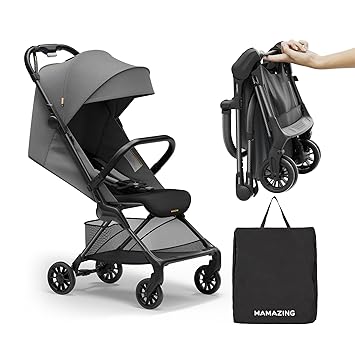
The ultralight sleeper hit we weren't expecting to like delivers—less than 10 lbs, one-handed fold, and a true budget price.
This is the sleeper hit of the entire review.
I’d never heard of MamaZing before testing. When I saw the price, I assumed it would feel like a $200 stroller: flimsy, janky, the kind of thing that makes you mutter “you get what you pay for” while wrestling it through airport security.
I was wrong.
The first thing I noticed when I picked it up was the frame. A lot of cheaper strollers feel creaky and rickety when you push them, like they’re one rough sidewalk away from structural collapse. This one doesn’t. The frame is carbon fiber, and at 9.9 pounds — the lightest stroller in this entire lineup — it feels solid. Almost absurdly light, like they forgot to finish assembling it, but solid in the way that matters: no creaking, no flex, no sense that it’s about to give up on you mid-trip.
You can carry it one-handed while wrangling a toddler with the other. Its low weight makes it easier to carry between the car, terminal, and gate. Portability scores a 9/10 for a reason.
The fold is solid: 7/10. Not Joolz-level instant, but better than most strollers at any price. You won’t be practicing it in your living room the night before a trip.
The downsides matter, so let’s be clear about them. Ride quality is fine, not amazing. You’ll feel rough sidewalks more than you would with the MINU V3. The storage basket is small. And the ones that might be a dealbreaker: it’s for babies 6 months and up, and there are no car seat adapters — don’t buy this as a newborn travel solution. Some MamaZing marketing pages claim from-birth / 55 lb; MamaZing’s buying guide says 6+ / about 50 lb, and we follow that stricter reading. If you need a from-birth setup, look at the Joolz or MINU options above.
But if your baby is already sitting up and you want the lightest, most affordable travel stroller on the market? Nothing we tested comes close. After several months of testing, including some genuinely rough handling during our extended comparison runs, the frame has held up without issue. This is your stroller.
Best for: Budget-conscious families, lighter packing, kids 6 months and up.
Colugo Compact+: budget pick runner-up ($199)
Weight: 16.2 lbs | Fold score: 8.5/10 | Overall score: 73/100
Choose this if your baby is between 4 and 6 months old, you want an auto-fold with no latch, or the included accessories bundle tips the math in its favor.
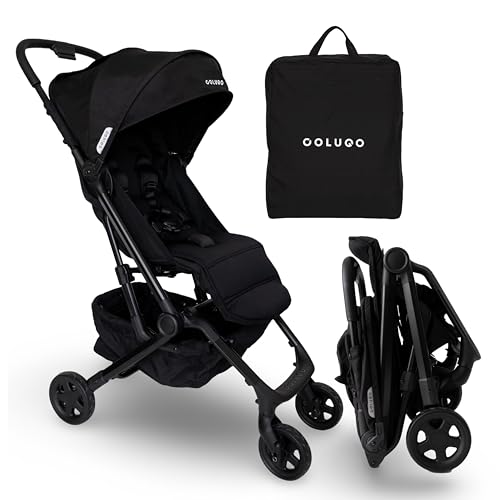
The budget pick with non-budget features and quality
Here’s the thing about the Colugo: it actually outscored the MamaZing Ultra Air X in our testing. 73 to 72.
So why isn’t it my top budget pick?
It weighs over six pounds more than the MamaZing. If carry weight is your priority, that matters more than the score gap. The Colugo still has a few good reasons to pick it.
The most important: the Colugo starts at 4 months. The MamaZing is 6 months and up per MamaZing’s buying guide (some MamaZing pages claim earlier — we don’t). Colugo lists the Compact+ from 4 months, so it’s the budget pick that covers that younger window.
The fold is also genuinely better. One-handed auto-fold, no latch, done in two seconds. Smoother than anything else in the value tier.
And the included accessories are worth factoring in. The Colugo comes with a carry bag, rain cover, and cup holder in the box — Colugo values that bundle at $80. If you’d buy those accessories anyway, fold them into the total when you compare.
The build quality is noticeably better across the board. The push is smoother, the liner is machine-washable, the handlebar is taller (Colugo specifically calls it “tall-parent approved“), and the basket is bigger.
One thing to be clear about: the Colugo does NOT have car seat adapters. It is not a newborn stroller. If you need something from day one, look at the Joolz Aer 2 or MINU V3.
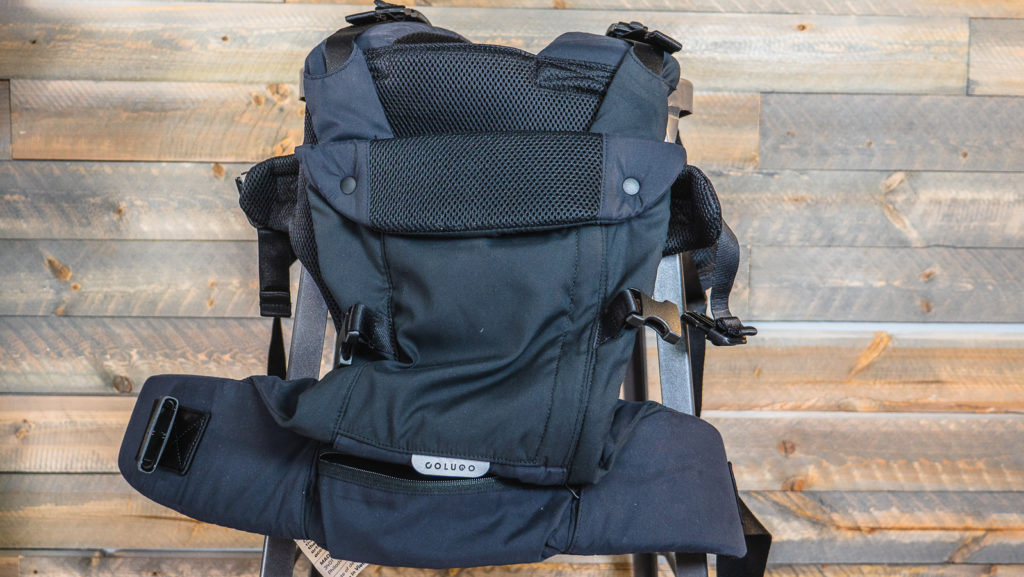
Colugo also makes a baby carrier, we reviewed that too.
The downside: 16.2 pounds is a lot for a budget travel stroller. You’ll feel the weight difference vs. the MamaZing on any long airport haul.
If carry weight is the priority: go MamaZing. If you want the auto-fold, the included accessories, or you’re in Colugo’s listed age window: go Colugo. Check live prices — the Compact+ everyday price is now $199.
Best for: Babies 4-6 months, tall parents, anyone who values the auto-fold or included accessories bundle.
Buy at Colugo or Buy on Amazon.

We go deeper on the Colugo Compact+ in our review, here.
Tier 3: travel strollers to avoid
Before I get into the disasters, one note: a great stroller buys you convenience. It doesn’t buy you patience.
The gear is solvable. The mental load of traveling with small kids — the tantrums at hour two of a flight, the negotiating over snacks like it’s a hostage situation, the fact that your child will choose the worst possible moment to have a meltdown — that’s different. If you want the “software” to go with this “hardware,” check out the Father’s Ed, our video course for dads-to be. Built to upgrade your dad software.
Now. The disasters.
I’m not being dramatic. Some of these strollers are bad in ways that should embarrass the brands selling them.
Stokke YOYO3: $499 (Avoid this one)
The YOYO 3 is, by far, the worst stroller I tested.
Let’s start with the fold, which is catastrophically bad. I’ve tried it 47 times. I’ve watched YouTube tutorials. I’ve practiced in my living room like I’m rehearsing a magic trick for a toddler’s birthday party.
I still can’t do it consistently.
Here’s what’s supposed to happen: you press a button, fold the handlebars back, squat down to the ground, execute a two-stage button push located directly on the underside of the stroller, then push it forward while simultaneously lifting it up, which supposedly swings it closed.
Of the 47 times I’ve tried it, that process has worked seamlessly zero times. It typically makes it about halfway through before collapsing on itself.
This is after you’ve assembled the thing, because yes, this $499 stroller arrives as a deconstructed six-piece kit. Like you just found a killer deal from IKEA’s bargain bin. I’m glossing over this part because none of us have the time for me to fully unpack how terrible that experience was, and you’re not my therapist.
But it gets worse.
The rear wheels are too close together, so the stroller tips on turns. Not aggressive cornering. Normal turns. “Trying to get around a trash can” turns. Your kid will learn physics through lived experience.
The storage basket is nearly inaccessible due to the narrow frame. When folded, the whole thing won’t stay upright. It just topples. And for reasons I cannot explain, the headrest is fully exposed when folded, so every time it falls over, the part where your baby’s head goes is now resting on the airport bathroom floor.
Stokke generally makes excellent products. We were big fans of their Tripp Trapp high chair, which makes the YOYO 3 all the more baffling.
The only redeeming qualities: the shocks are decent, and when it’s finally folded — after you’ve completed the ritual and made the appropriate sacrifices — it’s slightly more compact vertically than competitors. The shoulder strap is comfortable.
None of that matters when using the stroller is a lesson in suffering.
$499 for a product that makes you question your competence as a functioning adult. If you buy this stroller and I find out, I will come to your house and chew you out in person.
The YOYO’s defenders will point to its pedigree (Babyzen’s cult following was real), its shocks (decent), and its carry strap (the best in this test). If you do your folds in the living room and rarely need to do it one-handed under pressure, you might never hit the wall we did. We’d push back: travel with small kids is defined by high-pressure moments. A fold that works at home and fails at the jet bridge isn’t a travel stroller. It’s a home stroller that travels. But if the aesthetics matter and you’re primarily using it on city walks where you can take your time? I can see why people buy it.
Bugaboo Butterfly 2 — $599 (avoid)
The Bugaboo Butterfly 2 is the most expensive stroller in this test. And it does have strong qualities: smooth ride, excellent shocks, solid build.
So what’s the problem?
The fold doesn’t work.
I don’t mean it’s bad. I mean it literally doesn’t lock eight out of ten times. You fold it down, and instead of clicking into place like a functional piece of engineering, one half just flops open. Like it’s mocking you.
So you end up needing your second hand to shove it closed while quietly cursing whoever signed off on this mechanism.
For a $599 stroller, that’s insane.
And even when you do finally wrestle it closed, the fabric balloons outward. The Joolz Aer 2 folds down to about nine inches thick: tight, compact, clean. The Butterfly 2 bulges awkwardly, like someone stuffed a down jacket into a suitcase and called it a day.

For a travel stroller — a category defined entirely by portability — this is a disqualifying failure.
Searching for a Bugaboo Butterfly alternative? The Joolz Aer 2 costs less, folds better, and weighs less. Start there.
Great ride. Terrible travel stroller. Next.
Where to buy? Honestly, don’t. But if you must, Amazon
Ergobaby Metro 3 (avoid)
The Ergobaby Metro 3 feels like someone tried to clone a premium stroller, made it 30% bulkier, and forgot to fix any of the problems.
It’s too big. Too heavy. The fold doesn’t lock, which sounds like a minor inconvenience until you’re pulling it out of the trunk at the zoo and one half falls open while you’re holding a squirming toddler with your other arm. I tested this at the zoo. I tested it at the farmer’s market. Getting it in and out of the car was the most frustrating part of both outings.
Ergobaby lists the Metro 3 at 22 × 17.3 × 9 inches folded. That’s compact on paper, but airline bins and policies vary — don’t count on cabin storage until you check your flight.
The build quality feels clunky in a way that makes you wonder if anyone at Ergobaby actually took this thing on a plane before deciding to sell it.
Too much “meh” energy. Skip.
Summer Infant 3D Lite — $89 (avoid)
I included one cheap Amazon umbrella stroller in this test for comparison purposes. Allow me to introduce you to a cheap Amazon umbrella stroller we included for comparison… the Summer Infant 3D Lite (Summer’s umbrella line now shows up under Kids2/Ingenuity, and a heavier steel 3Dlite ST exists — we tested the aluminum 3D Lite at about 13 lb, not the ST).
This is not a travel stroller. This is a punishment device.
It doesn’t fold compactly. It compresses sideways into a long metal yardstick that you drag through the airport like a piece of rebar you stole from a construction site.
The frame is a chaotic tangle of metal support bars fighting each other for dominance. The fabric feels like a cheap Halloween costume. And instead of a single handlebar, it has two separate handles, which means one-handed steering is off the table entirely. You need both hands, both arms, and possibly a spotter.
I genuinely do not understand the five-star reviews. The only reason to give this stroller a five-star review is if the thing you have to compare it to is a wheelbarrow.
If you landed on this page searching for a cheap travel stroller: please, just spend the extra money on the MamaZing Ultra Air X. It’s about $200, it’s carbon fiber, and it won’t make you question your life choices at the jet bridge.
$89 to hate your life. Absolutely not.
What about the GB Pockit and Baby Jogger City Tour 2?
We tested both of these in our original 2025 review, and they come up often enough in reader questions that they deserve a quick update.
The GB Pockit is legitimately impressive on one dimension: the fold. The GB Pockit’s tiny fold is its biggest selling point — it collapses small enough that some parents try under-seat storage; check your aircraft before you count on it. The miracle fades when you try to push it for more than twenty minutes. The GB Pockit’s core problem is that there is no handlebar. Two individual handles, no crossbar connecting them — which means one-handed pushing is off the table entirely. If you want to get a coffee, manage a carry-on, or just not look like you’re operating a lawnmower through the terminal, you need both hands on this thing. At that point you’ve given up the main reason to own a travel stroller. The MamaZing Ultra Air X is lighter, cheaper, and actually driveable with one hand.

The Baby Jogger City Tour 2 was our budget runner-up in 2025. It’s a solid stroller. But the Colugo Compact+ now offers better build quality, a smoother fold, and more features at a similar price. If you’re choosing between them today, go Colugo.
Which travel stroller is best for you?
Here’s how to cut through it.
If you fly frequently and portability is everything: Joolz Aer 2. It’s the best travel stroller for flying, and it’s not particularly close. One-handed fold, about nine inches thick when packed. This is the one I grab every single time I travel.
If you want the best ride for all-day use: UPPAbaby MINU V3. If your trips involve more walking than flying — cobblestone streets in Europe, the farmer’s market, long zoo days with a kid who refuses to walk — the MINU’s suspension makes rough terrain feel like smooth runways. It’s the best travel stroller for cobblestone and uneven surfaces in this lineup.
If you have a toddler and want the lightest possible stroller: MamaZing Ultra Air X. At 9.9 pounds, it’s the lightest travel stroller we tested. Perfect for kids 6 months and older (MamaZing’s buying guide; max about 50 lb).
If you have a newborn: check the Joolz Aer 2 and UPPAbaby MINU V3 approved newborn setups. A car seat with adapters is one option, not the only one — follow the manual for the exact model. Budget picks: Colugo Compact+ lists from 4 months; Ultra Air X treat as 6 months+ per MamaZing’s buying guide — neither is a from-birth stroller.

If your baby is 4-6 months: Colugo Compact+. Colugo lists the Compact+ from 4 months — that’s the budget pick in this window. Treat Ultra Air X as 6 months+ per MamaZing’s buying guide.
If you’re looking for the best budget travel stroller: MamaZing Ultra Air X when carry weight matters most (about $200–$250). Colugo Compact+ at about $199 if you want the auto-fold, the included accessories, or Colugo’s listed younger age window.
If you’re shopping for an older child: check the exact stroller’s age, height, and weight limits, then check seat and harness fit. Age alone doesn’t tell you whether it works. Look for enough room and a frame that survives the trip — the MamaZing wins on portability when they refuse to sit; the Joolz still has the best airport fold.
Everyone else: Skip ’em.
I know these aren’t cheap. But a bad travel stroller doesn’t just cost you money. It costs you time, patience, and sanity every single time you use it. Five extra minutes wrestling with a fold at the jet bridge. Three extra pounds through the airport. A tippy stroller that makes you nervous every time your kid leans forward.
That stuff adds up fast.
The strollers that survived this test aren’t just better products. They’re better experiences. When you’re traveling with a toddler who’s already operating at maximum chaos, that difference matters.
Bottom line: don’t buy based on hype. Buy based on what actually matters when you’re juggling bags, boarding passes, and babies.
Travel stroller FAQs
Can I use these strollers from birth?
The MINU V3 has a from-birth carriage configuration, and Joolz’s current US Aer 2 includes a newborn setup with a baby net. Both also offer car seat adapters. Follow the exact model’s manual for recline, harness, and accessories. Colugo lists the Compact+ for babies 4 months and older. Treat the Ultra Air X as 6 months+ per MamaZing’s buying guide (some MamaZing pages claim earlier — we don’t). For true newborn use, stick to the premium picks above.
For a full rundown of newborn-friendly gear, see our newborn baby essentials list.
Are they compatible with car seats?
Two of our four recommended picks are: the Joolz Aer 2 and MINU V3 both offer car seat adapter compatibility. The MamaZing Ultra Air X and Colugo Compact+ do not. If car seat compatibility matters to you, you’re in the premium tier. Check your car seat brand against each stroller’s specific adapter list, because compatibility isn’t universal.
Can you bring a stroller through TSA and onto the plane?
Usually yes — but check your airline’s stroller policy before you fly. Confirm whether you can gate-check it, whether a fee applies, and where you pick it up after landing. Gate-checking and bringing a stroller into the cabin are different arrangements.
The difference a good fold makes here is real. The Joolz Aer 2 goes from open to folded in under two seconds, drops into a gate-check bag in one motion. With a bad fold (looking at you, YOYO 3), that same process takes five minutes, a second pair of hands, and a willingness to hold up the entire boarding line. Don’t be that person.
Do they work on rough terrain? What’s the best travel stroller for Europe or cobblestone streets?
The MINU V3 gave us the best ride on the rough surfaces we tested. I didn’t test it on European cobblestones — that recommendation is based on park and sidewalk experience. It’s what I’d take to Europe or any city with older streets. The Joolz Aer 2 handles mixed surfaces well. The MamaZing rides noticeably harder on rough terrain — you’ll feel more of what’s under the wheels. If most of your walking is on smooth city sidewalks or airport floors, any of the recommended picks will handle it fine.
What is the lightest travel stroller?
The MamaZing Ultra Air X is listed at 9.9 pounds — lightest of our four recommended picks. The Joolz Aer 2 is next among those four at 14.3 pounds. The comparison table also includes lighter models we don’t recommend. At under ten pounds, you can lift the MamaZing one-handed while holding a toddler without thinking twice about it. Full review and details are in the value tier section above.
Is the Stokke YOYO 3 worth it?
No. I tested folding it 47 times. The fold worked seamlessly zero times. It arrives as a six-piece assembly kit, it tips on normal turns, and the headrest lands on the airport bathroom floor every time it topples over. For $499, it’s the worst value in this entire test. Full breakdown is in the disaster tier above — and if you’re looking for an alternative, the Joolz Aer 2 and MINU V3 are the strollers the YOYO 3 wishes it was.
What’s the best travel stroller for flying?
The Joolz Aer 2. One-handed fold, about nine inches thick when packed, and you can keep your kid strapped in until the moment the jet bridge door closes. It’s the stroller I fly with every single time, and for good reason. Full review is in the Tier 1 section above.
What travel strollers fit in the overhead bin?
Compact folds help, but airline bins and aircraft vary — don’t treat cabin storage as guaranteed. Among the strollers we tested, the Joolz Aer 2, UPPAbaby MINU V3, MamaZing Ultra Air X, and Colugo Compact+ are the ones parents most often try as carry-ons; measure folded and check your airline. The Stokke YOYO 3 is compact when folded, if you ever manage to fold it. The Bugaboo Butterfly 2 may fit depending on the aircraft, but the fabric balloons outward and makes it a squeeze. The Ergobaby Metro 3 (22 × 17.3 × 9 inches folded per Ergobaby) and Summer Infant 3D Lite are less likely to work as cabin bags — check your flight before you count on it.
When in doubt, measure your stroller folded and check the airline’s carry-on size restrictions. Policies vary, and some smaller regional aircraft have tighter bins than you’d expect.
What’s the best travel stroller for tall parents?
The MINU V3 is the most consistently comfortable option for taller parents across a full day of use. The Joolz Aer 2’s frame was updated in the Aer 2 version specifically to add height, which was a real improvement over the older Aer+. The MamaZing handlebar is less adjustable and can get uncomfortable for parents over six feet on longer outings. If you’re tall and this is a priority, the MINU V3 is the one to test first.
MamaZing vs. Colugo: which budget stroller should I buy?
Two questions: How old is your baby, and how much does weight matter to you?
If carry weight is the priority and you want the lightest recommended pick: MamaZing Ultra Air X. At 9.9 pounds, it’s over six pounds lighter than the Colugo. Carbon fiber frame, solid fold, and the best budget pick when weight matters most. Colugo Compact+ everyday pricing is now about $199.
If you want the auto-fold, the taller handlebar, the included accessories bundle (carry bag, rain cover, cup holder), or you’re shopping in Colugo’s listed younger age window: Colugo Compact+. Treat Ultra Air X as 6 months+; Colugo is the budget option that lists from 4 months.
Neither has car seat adapters. Ultra Air X: 6 months+ (buying guide / ~50 lb max). Colugo Compact+: lists from 4 months. Don’t treat either as a from-birth stroller — for newborns, look at the Joolz Aer 2 or MINU V3.
Still on the fence between the two? MamaZing if your baby is 6 months+ and you want the lightest, cheapest option. Colugo if age, auto-fold, or the included accessories tip the balance.
Travel stroller vs. travel system: which do you actually need?
A travel system bundles a car seat, car seat base, and stroller into one compatible set. A travel stroller is just the stroller — usually lighter, more compact, better for flying. If your baby is a newborn and you’re primarily doing car trips and errands, a travel system makes sense: you click the car seat in and out without waking them. If you’re flying or traveling internationally, a dedicated travel stroller paired with a separate infant car seat is almost always better — travel systems are bulky, heavy, and painful at airport security. The Joolz Aer 2 and UPPAbaby MINU V3 both accept car seat adapters, so you can run either as part of a compatible system without buying a full travel system bundle. For a full breakdown of full-size stroller options (including travel systems), see our best strollers guide.
Meet Fathercraft
Looking for more Fathercraft? Check out our list of baby essentials or our other product reviews.
Editor’s note: this list was originally published in May 2025, and most recently updated in September 2026 for Colugo Compact+’s permanent $199 everyday price and related pricing and accuracy fixes.