
You found out you’re going to be a dad. Congratulations, and welcome to one of the best, hardest, most disorienting jobs you’ll ever have. I found out on Christmas Eve, when my wife tossed me a pregnancy test, and somewhere between the joy and the cold sweat one thought drowned out the rest: I had no clue what I was doing. I’d never held a baby. I didn’t know if drink water (they don’t). So if you’re staring at the wall doing the thousand-mile stare right now, this new dad checklist is the one I wish someone had handed me: twelve things to actually do before the baby comes, gear, paperwork, and other prep. It’s like a 12-step program for guys like I was… lost and feeling alone.
Most of us have no idea what we’re doing. That’s normal. The point of a checklist for new dads isn’t to make you an expert by Tuesday — it’s to make sure the important stuff gets handled while you’ve still got time and two free hands. There’s more on the emotional side of all this in my longer piece on becoming a dad for the first time. For now, let’s knock out the list.
Twelve things to do before the baby comes — jump to any of them:
1. Read up
Get educated on what to expect, and start early. Read as much as you can, know the information can pile up fast, and some books lean hard into everything that can go wrong. A few will scare you out of your recliner. Temper the reading by talking to other parents who’ve actually been through it. No book and no piece of advice covers every base, but together they’re a solid foundation. Read, take notes, scribble in the margins; you’ll surprise yourself years later when you’re a pro.
Make it happen: start with our list of the best books for new and expecting dads.
2. Find a birthing class
Through your partner’s OB/GYN or the hospital, you can sign up for a birthing class — and it’s worth it. Movies turn these into a cliché of couples on yoga mats doing breathing exercises, but a real class gives you focused time on what your partner is going through, explained plainly. Childbirth gets mystified or played for laughs (the frantic race across town), and it’s actually a natural process with a lot of unglamorous parts: gas, nipple sensitivity, pain, anxiety, and more. A good class gets you past the squeamishness and usually connects you with other couples in the same boat. You’ll see fast that everyone handles it differently.
Make it happen: check in with your partner’s OBGYN or the local hospital where your partner plans to give birth. These book up, so don’t wait til month 8.
3. Attend a daddy bootcamp or take an online course
One of the most useful and most overlooked moves: a hands-on bootcamp. Hospitals and local groups run interactive classes that put real skills in your hands, and some bring in actual newborns so you can practice swaddling, diapering, and burping before it counts. There are no dumb questions here, so leave the jokes at the door and keep your eyes and ears open. Prefer to learn from your couch? Plenty of online options exist too.
Make it happen: search for local daddy bootcamps, or check out our very own Father’s Ed video course, the new dad class we built for this exact moment.
4. Get involved
Your partner is carrying the baby, but that doesn’t make the pregnancy her solo project — and it doesn’t make you the supervisor of it, either. It’s a partnership. How well the two of you work together now sets the tone for later, when your kid starts asking the hard questions. Get on the same page, or at least learn to disagree respectfully, and you’ll have a smoother ride and raise kids who understand healthy boundaries.
Make it happen: demand your partner doubles her prenatal vitamin dose, then start to get more intrusive. JK, terrible idea. Instead, attend OB appointments, and ask how you can support.
5. Set a good game plan
Talk through what you both expect — division of labor, parenting approach, even discipline. None of it is written in stone, and you’ll adjust as you go, but agreeing on who does what (and working in shifts once the baby’s here) makes both your lives easier. Exhaustion has a way of rewriting the dishes-duty schedule, so build in some give.
While you’re at it, surface the stuff that never came up over dinner when you were dating: religious ceremonies, circumcision, vaccinations, how long the in-laws get to camp out after the baby arrives. Better to find the disagreements now than at 3 a.m. on day four.
Make it happen: work through our checklists for expecting parents, which include prompts on conversation starters for couples.
6. Start to think about your parenting style
Brainstorm with your partner about the kind of parents you want to be. A lot of us run on reaction: “my parents were too hard on me, I’ll never do that,” or the opposite. The small stuff (cry-it-out vs. not, co-sleeping—don’t, at least not when they’re under one—how much to hold the baby) is much easier to talk through now than mid-argument when you’re both wrecked and emotional. Consistency matters to a kid, and a united front, and knowing how to disagree without a blowup, buys you a lot of ground later.
Make it happen: jot down a few notes about what went well and what didn’t in your own childhood, then trade with your partner. It’s a deep starting point, but a powerful one. If you want a primer on what’s coming trimester to trimester, our pregnancy week by week for dads has you covered.
7. Get some toys
Parenthood is not all soft-molded plastic animals in obnoxious colors. You get some toys, too. There are more cool baby gadgets and ways to make your life easier than James Bond gets from Q these days. Baby monitors, strollers, wagons, car seats, HD surveillance systems, diaper bags for dads, and all the other accoutrements of being a new dad are a flat-out blast to use. Most of this stuff is available in designs and colors that don’t make you look like you are carrying around a bunch of plastic junk or pink-polka-dot bags anymore.
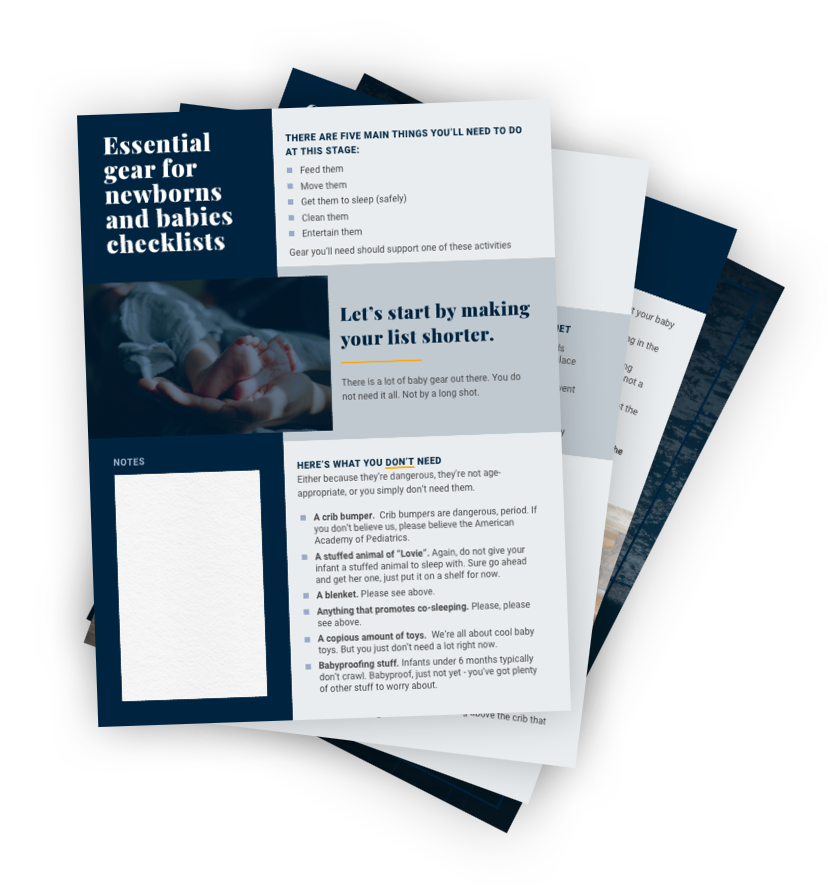
Make it happen: get the basics (and the beyond-basics) sorted our newborn essentials list.
8. Get all cozy and start nesting
You may have heard about nesting; it’s something else to watch up close. As odd as it sounds, the partner who used to be all about sushi bars and rock climbing can end up deep in a debate over lemon yellow versus canary yellow for the nursery — and it’s completely real. As the due date closes in, the honey-do list grows. You might walk in to find a project already underway. Lean into it: this is a fun stretch to make the house a home together. Knock out that last deep clean and the projects you’ve been putting off, because your hands will be full soon. Just keep them safe for mom and short enough that you can finish before the baby shows up.
Nesting often includes:
- Repainting rooms
- Wallpaper
- Deep cleaning
- Shampooing carpets, refinishing floors
- Rearranging furniture
- Setting up the crib, bassinet, swing, changing table
- Baby-proofing the house
- Clearing out the attic, garage, or basement
- Fixing that leaky plumbing
- Many, many more
Make it happen: head to Home Depot, Pottery Barn Kids, Target… whatever’s your weapon of choice. Even the most self-described manly man can get weirdly into this… and that’s a good thing.
9. Find a pediatrician
Believe it or not, you’ll be at the doctor a lot as a new parent — vaccinations, post-natal tests, well-checks, plus the inevitable first virus, cradle cap, rashes, and baby acne. Even with a perfectly healthy kid, a good pediatrician is your go-to reference for development questions, not just emergencies. Plenty of ways to find one, but word of mouth beats any online review, especially when a friend has had a great (or not-so-great) run with theirs. Bedside manner, your kid’s comfort, and the doctor’s experience all matter.
Make it happen: ask three friends who are parents about their pediatrician, or search for board-certified options close to home — you don’t want more than a 10–15 minute drive. Immediately rule out anyone wearing a clown nose in their headshot.
Talk about feeding: breast, bottle, or both
This one’s important and personal. Learning about it before delivery prepares you both for the challenges — latching trouble, nutrition, and just finding time. From breast pumps to formula, it deserves a real conversation rather than a wing-it-in-the-moment approach.
Make it happen: start the talk with your partner and get her initial read. Then bring it up with her OB and your new pediatrician — it makes a great interview question when you’re choosing that doc.
11. Get or update your life insurance and will
A buzzkill to think about while you’re bringing a life into the world, sure — but as a dad your job is to provide for your kid even after the worst-case scenario. Now’s the time to talk with your partner about guardianship, financial support, and how your child would be cared for if something happened to one or both of you.
Make it happen: talk through your wishes together, then look into term life insurance — it’s often cheaper than you’d guess, but it can require a medical exam and a few weeks to process, so start early.
12. Prep for labor and delivery
Very few labor stories play out like the movies, which is a good thing. Childbirth often unfolds over a couple of days. Have a birthing plan, but hold it loosely — plans shift with the situation, and every birth is different.
Here’s what to know and expect when the time comes.
Hurry up and wait
By now the basics of anatomy and biology should be familiar. Quick refresher: the baby gestates over roughly 40 weeks, getting everything it needs through the placenta, often hanging out upside down until the uterus is ready to evict it. The body floods with hormones — oxytocin, serotonin, cortisol — that get things moving and help the cervix dilate from pinhead to roughly grapefruit size, measured by the doctor and nurses along the way. It can take a few hours or a few days. If any of these terms make you squirm, work on that now, because you’ll be hearing them a lot.
Water breaking
You probably know this one. The amniotic sac ruptures and the fluid that’s been cushioning the baby drains out, often along with the mucus plug. Watch for any discoloration or blood in the fluid and tell the medical team right away, since it can signal meconium or distress. Broken water is often a sign labor has started — though not for every mom, and sometimes the doctor ruptures the sac manually, which is also normal.
Contractions
Contractions are uncomfortable, to put it mildly. Your partner may be encouraged to walk, which helps move labor along. They come and go throughout; consult your doctor, but contractions several minutes apart generally point to true labor, while irregular ones can mean false labor. You’re not a doctor (unless you are), so don’t try to diagnose — just keep the questions flowing with the medical team.
Pain management
Painful is one word for it. Agonizing is another. Be ready to talk pain management with the doctor early, because there’s a limited window to administer an epidural before active labor is underway.
Active labor
This is the part Hollywood plays up — the contractions, the breathing, the noise. Everyone’s experience is different, so don’t measure yours against the movies. It’s a challenge with an incredible payoff. Don’t take anything your partner says during active labor personally. Be supportive. Participate. And try not to be the dad who faints at delivery.
Delivery
Now things move fast. The baby arrives — vaginally or by C-section, each with its own challenges — and the doctor will probably hand you the scissors to cut the cord. The rest is a blur. Hold on for dear life.
Post-labor recovery
This is the stretch where mom rests and your new life together begins. Ask the doctor what to watch for, including signs of postpartum depression and anxiety. Be supportive and accommodating — your partner just went through more than you can imagine.
Taking baby home
You’ll need the right equipment to bring your child home, starting with the one non-negotiable: the hospital won’t let you leave unless the baby is buckled into a proper infant car seat. The rest is up to you.
Make it happen: tour your hospital, do the prep work ahead of time, expect the unexpected — and know you’ve got this.
Good luck. You got this.
If you’ve read this far, here’s my read on you: you’re going to be a great dad. Not because you’ve got it figured out — none of us do at the start — but because you cared enough to read this far. That care is most of the job.
When you’re ready for the next step, Father’s Ed is the new dad class we built for this exact stretch: short, practical, research-backed videos (and, yes, dad jokes) that take you from “never held a baby” to actually confident. You can try it for just a dollar right here. If you’d rather read, our roundup of the best books for expecting dads is where I’d start, and the newborn essentials list will get your gear dialed in without the guesswork. Want to know what’s happening week to week? Pregnancy week by week for dads breaks it down.
And if you learn better by watching, come hang out with us over on YouTube. We’ve got two channels: one where we put baby gear through its paces so you don’t have to, and another that focuses on the soft skills: think of it like personal development for dads and couples entering parenthood. Whatever you do next, enjoy the journey; it goes faster than anyone tells you.
New dad checklist FAQ
What should be on a new dad checklist?
Twelve things, all before the baby arrives: read up, take a birthing class, do a dad bootcamp or online course, go to OB appointments and get involved, agree on a game plan with your partner, talk through parenting style, get the core gear (car seat, baby monitor, stroller, diaper bag), nest and baby-proof, pick a pediatrician, settle a feeding plan, sort life insurance and a will, and prep for labor and delivery. Our complete dad-prep checklists here.
When should a dad start preparing for a baby?
Start in the second trimester. Birthing classes and dad bootcamps fill up months ahead, term life insurance can take weeks thanks to the medical exam, and finding a pediatrician you click with takes a few conversations. Get the big gear sorted by month seven and you’ve left the third trimester for nesting and rest.
What does a new dad actually need before the baby arrives?
The true must-haves are short: an infant car seat (the hospital won’t discharge you without one), a safe place for the baby to sleep, diapers and feeding supplies, and a baby monitor. Everything else is comfort and convenience. The full breakdown is in our newborn essentials list.
Do dads need to take a birthing or baby class?
You don’t strictly need one, but a birthing class and a hands-on dad bootcamp are two of the highest-value things you can do. The class demystifies labor and gets you and your partner aligned; the bootcamp gives you reps at swaddling and diapering before it counts. Prefer to learn at home? An online course works too.
What should a dad do during labor and delivery?
Have a birthing plan, but hold it loosely. Your job is support: help your partner stay comfortable through contractions, talk to the medical team, ask questions, and don’t take anything she says during active labor personally. Tour the hospital ahead of time, have the car seat installed, and try not to be the one who faints. For the emotional side, I wrote this on becoming a father.