
Sponsored: Philips Avent paid Fathercraft to make our video review and this article, and sent the monitor for free. They didn’t get to touch my opinions. If I thought this thing was bad, you’d be reading a very different review. Fathercraft may also earn a commission if you buy through links on this page.
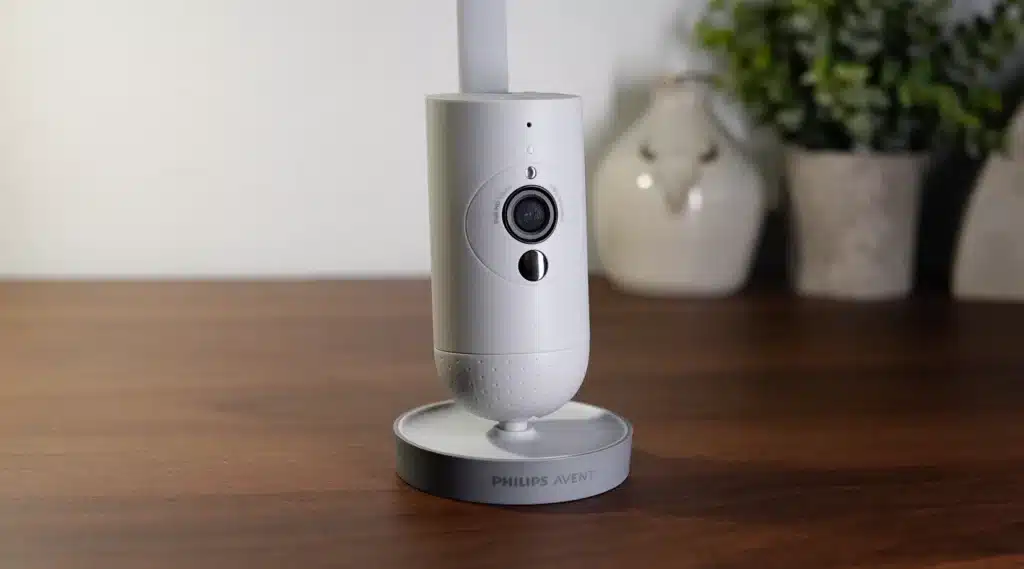
The Philips Avent Premium Connected is the only baby monitor I’ve tested with breathing tracking, no wearable, no subscription, and a parent unit that works without Wi-Fi. Four things, one box. I used it on my son Dean for about five weeks, and it’s good at both jobs a monitor has, without being the best at either.
The short answer
Philips Avent Premium Connected (SCD973/37), tested for 5 weeks, as of October 2026. The camera’s SenseIQ feature reads the tiny up-and-down of a baby’s chest and shows live breaths per minute plus awake, light-sleep, or deep-sleep status, with no wearable and no subscription for the breathing and sleep data. It has a 1080p camera and a 5-inch parent unit that works without Wi-Fi; the app works over Wi-Fi. Overall I give it a 9.0 out of 10, and the picture a 9 out of 10, too. The catch: SenseIQ needed the camera close. It stopped working at 6 feet and 5 feet and came back at about 3 feet on the crib pole. It is a breathing tracker, not a breathing alarm, and Philips says it is not a medical device. Buy it if you want sleep and breathing data without a sock or a monthly bill. Skip it if you want alerts for breathing interruptions.
Check price: Philips Avent Premium Connected Baby Monitor SCD973/37 (crib + wall mount)
Philips Avent baby monitor verdict
I think baby monitor parents come in two camps. Data parents want breathing, sleep stages, when he went down, and how many times he stirred. That’s usually a first kid. “Just show me the baby” parents want a clear picture, clear audio, and a screen that works when the Wi-Fi doesn’t. That’s usually a second kid.
Most of us are both, just not at the same time. With Hank I checked the app like it was the stock market. With Dean, I mostly want to know he’s horizontal.
The Philips Avent Premium Connected is good in both camps. The Nanit has deeper data, and the Eufy E21 is the cleaner simple monitor. But nothing else I’ve tested combines breathing tracking, no wearable, no subscription, and a Wi-Fi-free parent unit. That happens to match how most of us actually parent: data parent for a few months, then just show me the baby.
My grade: A-minus, 9.0 across the board.
Best for: first-time parents who want breathing and sleep reassurance without a wearable or a monthly bill, and who want a monitor that’s still useful once they’ve calmed down.
Main drawback: SenseIQ needs the camera close (about 3 feet on the crib pole in my testing), which conflicts with my usual six-foot rule.
Skip it if: you want a monitor that alerts you to breathing interruptions (that’s not what this is designed for), or you already know you’ll never open the sleep data. Get a simple monitor and save the money.
Philips Avent Premium Connected Baby Monitor SCD973/37 (crib + wall mount)
How we tested the Philips Avent Premium Connected
- Tester: Mark Zalewski. I’ve reviewed about 14 baby monitors over the past few years.
- Unit: Philips Avent Premium Connected with the crib pole (SCD973/37), provided free by Philips Avent as part of a paid partnership.
- Duration: about 5 weeks, nightly, on our younger son Dean (about 5 months old during testing), in our bedroom.
- What I checked: setup, day-to-day use of the parent unit and app, SenseIQ breathing and sleep readouts (about 3–4 hours of watching the breathing number in total), night vision, the alerts, placement distance (6 ft, 5 ft, and about 3 ft), and EMF with the same meter and method I use for every monitor (see our Wi-Fi baby monitor EMF testing).
- What I couldn’t test: breathing-rate accuracy against a reference device. Philips doesn’t publish an accuracy spec, and my eyeballs are not a medical instrument.
How SenseIQ tracks breathing with just a camera
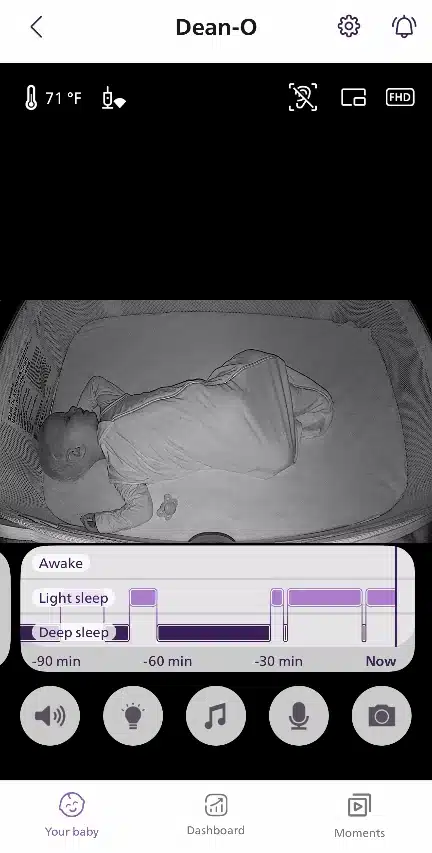
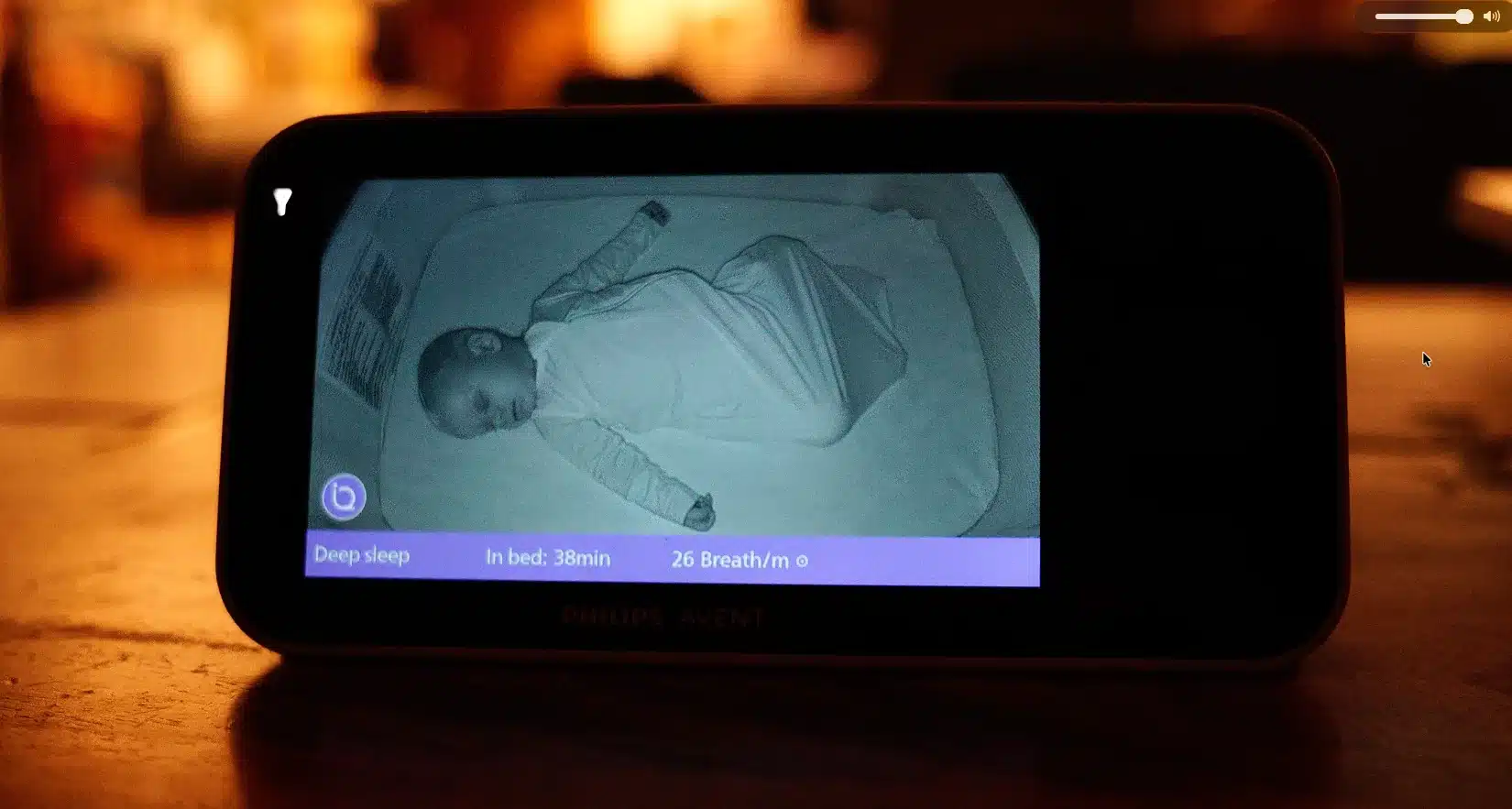
Philips calls the smart features SenseIQ. The camera watches the pixels on your baby’s chest and turns that tiny up-and-down into a breathing rate and a sleep state. Philips told us SenseIQ also uses breathing-rate variability and body movement to work out the sleep stage. Nothing physically touches the baby.
What you get, as of October 2026:
- Live breaths per minute
- Awake, light sleep, or deep sleep
- A timeline of the last 90 minutes
- A sleep diary that goes back about a month
The only other monitor I’ve seen track breathing without a wearable is Miku, and Miku charges about $10 a month for the privilege (our Miku review).
Sleep state tracking: the feature I actually use
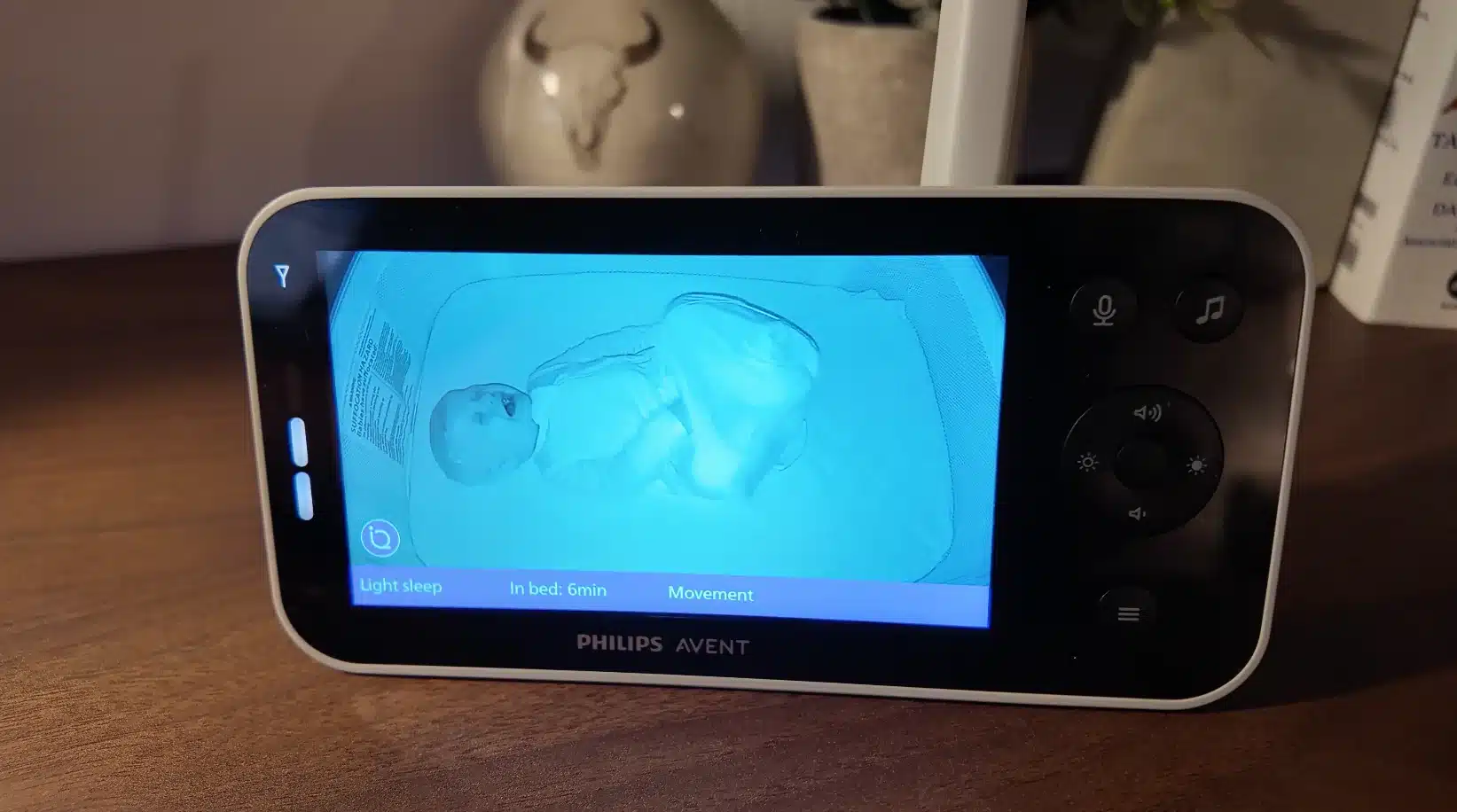
The feature I use most isn’t the breathing number. It’s the sleep state. At 9:30, while my wife and I are watching a show, I glance at the app and see deep sleep for the last forty minutes.
That one glance replaces tiptoeing to the door, opening it one inch, and getting caught like a raccoon at a trash can because the hinge squeaked for a quarter of a second.
The light-sleep indicator has genuinely stopped me from going in. Babies are noisy in light sleep. They grunt, they thrash, and they sound like they’re negotiating with someone. If Dean is making noise but the app says light sleep, I watch for a moment before going in. I’m still looking at him and listening, but that extra bit of information helps. From what I can tell, it’s been quite accurate.
Is SenseIQ breathing tracking accurate?
I watched the breathing number for three or four hours total over five weeks, and it looked right to me the whole time. I don’t have a reference device to check it against, and Philips doesn’t publish an accuracy spec.
No breathing alarm: SenseIQ is not a medical device
So nobody buys this for the wrong reason: the Philips Avent Premium Connected is a breathing tracker, not a breathing alarm. It shows you a rate. It does not sound an alarm if breathing stops.
Philips says the monitor is not a medical device and is not intended to detect breathing interruptions. It won’t tell you about every breathing or sleep irregularity, and it doesn’t replace adult supervision (Philips FAQ: “Is Avent Premium Connected Baby Monitor a medical device?”, as of October 2026).
If SenseIQ can’t pick up a breathing rate and sleep state, Philips told us the monitor sends a “SenseIQ signal cannot be detected” notification to your phone and the parent unit. Philips told us that notice can have several causes, and it is not a medical breathing alarm. Treat it as “the tracker can’t see well enough right now,” not “something is wrong with the baby.” In five weeks I never once got that notification. The only warning I saw was the camera telling me it was too far from the baby, when I had it about six feet away.
If you want a device that notifies you when readings move outside a range, that’s a different product: the Owlet Dream Sock. It’s a sock sensor that monitors pulse rate and oxygen saturation and notifies you when those readings go outside preset ranges. Owlet says its oxygen readings are accurate to within 3% of arterial blood gas measurements (Owlet Dream Sock product page, as of October 2026). Owlet also says the Dream Sock is for healthy babies 1 to 18 months old and 6 to 30 lbs, and not for babies with ongoing health conditions (Owlet: Dream Sock intended use). If your baby has a medical condition, ask your pediatrician what monitoring they recommend. (Our Owlet review.)
My opinion (I’m a dad, not a doctor): I’m not going to put a sock on a healthy baby. The Owlet is the medical-grade baby monitor, and that’s where I’m pushing a parent whose kid just came out of the NICU, after they’ve talked to their pediatrician.
What the labels say (as of October 2026):
- The FDA granted the Owlet Dream Sock De Novo authorization in November 2023 (FDA DEN220091) as an over-the-counter monitor for healthy infants 1 to 18 months old and 6 to 30 lbs.
- Owlet says the Dream Sock is not intended for babies previously diagnosed with heart or breathing conditions.
- For babies with medical needs, Owlet sells BabySat, an FDA-cleared version that requires a prescription.
- The Philips is not a medical device at all. It’s built to show you what you can’t see from the doorway: that your baby is breathing steadily and sound asleep. For me, that’s helpful information.
Setup, app, and the 5-inch parent unit
Setup is three parts: camera, parent unit, and mount. You attach the crib pole to the crib, and the camera pairs in under ten minutes.
I come from a product background, so I notice when an app actually helps you get started. The first time you open this one, little arrows pop up: “Welcome. This is the main video screen.” Tap. “This is where you turn on lullabies.” Tap. It walked me through itself like a very polite museum docent. It’s a small touch, but it reduces the learning curve a fair amount.
Day to day, you get a parent unit and an app. The parent unit talks straight to the camera with no Wi-Fi required. The app works over Wi-Fi from anywhere, and the system picks between them on its own. Five weeks in, I haven’t once thought about which mode it was in. That’s the right amount of thinking. (Philips says SenseIQ needs a one-time Wi-Fi connection during setup and then works with or without Wi-Fi: Philips FAQ: “Does SenseIQ monitoring require Wi-Fi?”.)
Picture quality: 9/10 (my rating). It has a 1080p camera, a 5-inch screen, and really solid night vision. It’s not the single sharpest image I’ve seen, but it’s in the top tier, and a clear step up from the Nanit, which trades pixels for all the math it’s doing.
You also get two-way talk; motion, sound, and cry alerts on your phone; room temperature with high and low alerts; a night light; and a pile of lullabies and white noise.
Downsides: what I’d change
1. Zoom on the parent unit. There are no zoom buttons. Zoom lives in the menu and takes five button presses. It’s 2 a.m., my baby has moved, and I’m navigating a submenu like I’m setting the clock on a microwave. On the phone, at least, you can just pinch. There’s also no motorized pan or tilt; the camera points where you point it.
2. The screen wakes for sound, not motion. I want the parent unit to go dark and wake up when something happens. It wakes up for sound. It does not wake up for motion. The Eufy E21 doesn’t either, but the VTech VM924 does it for under $80 (as of October 2026), so I’m allowed to want it.
3. Two paid add-ons. No subscription is required for the breathing and sleep tracking, and that’s what makes this monitor interesting. Philips told us everything in the app (sleep schedule, weekly and monthly sleep diary, live sleep status, and breathing rate) is included. Two services are paid, as of October 2026:
- Cry Translation listens to the cry and guesses hungry, tired, or gassy. It’s free for 3 months, then a monthly fee. I’m curious about it. My current system is trying three things until he stops yelling.
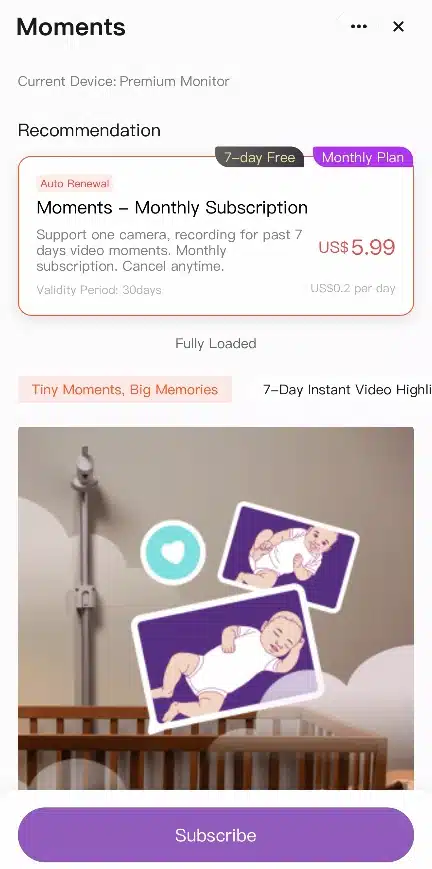
- Moments are cloud-stored video clips (Philips says up to 30 seconds each, stored up to 7 days: Philips FAQ: “What is Moments, and how do I subscribe?”). It’s $5.99 a month after a 7-day free trial, and it auto-renews unless you cancel (in-app subscription screen, October 2026). I liked it, but I didn’t find it earth-shattering.
Camera placement: SenseIQ needs to be close to the crib
I normally mount every monitor at least six feet from the crib. Because of where Dean’s crib is in our bedroom, I couldn’t wall-mount this one, so I jerry-rigged a floor stand out of a tripod and some duct tape and put the camera six feet up.
SenseIQ stopped working. I tried five feet and got nothing. I clipped it back on the crib pole, about three feet away, and it came right back. Placement matters. At six feet, the app flat-out told me it was too far from the baby. Dean was about five months old during testing.
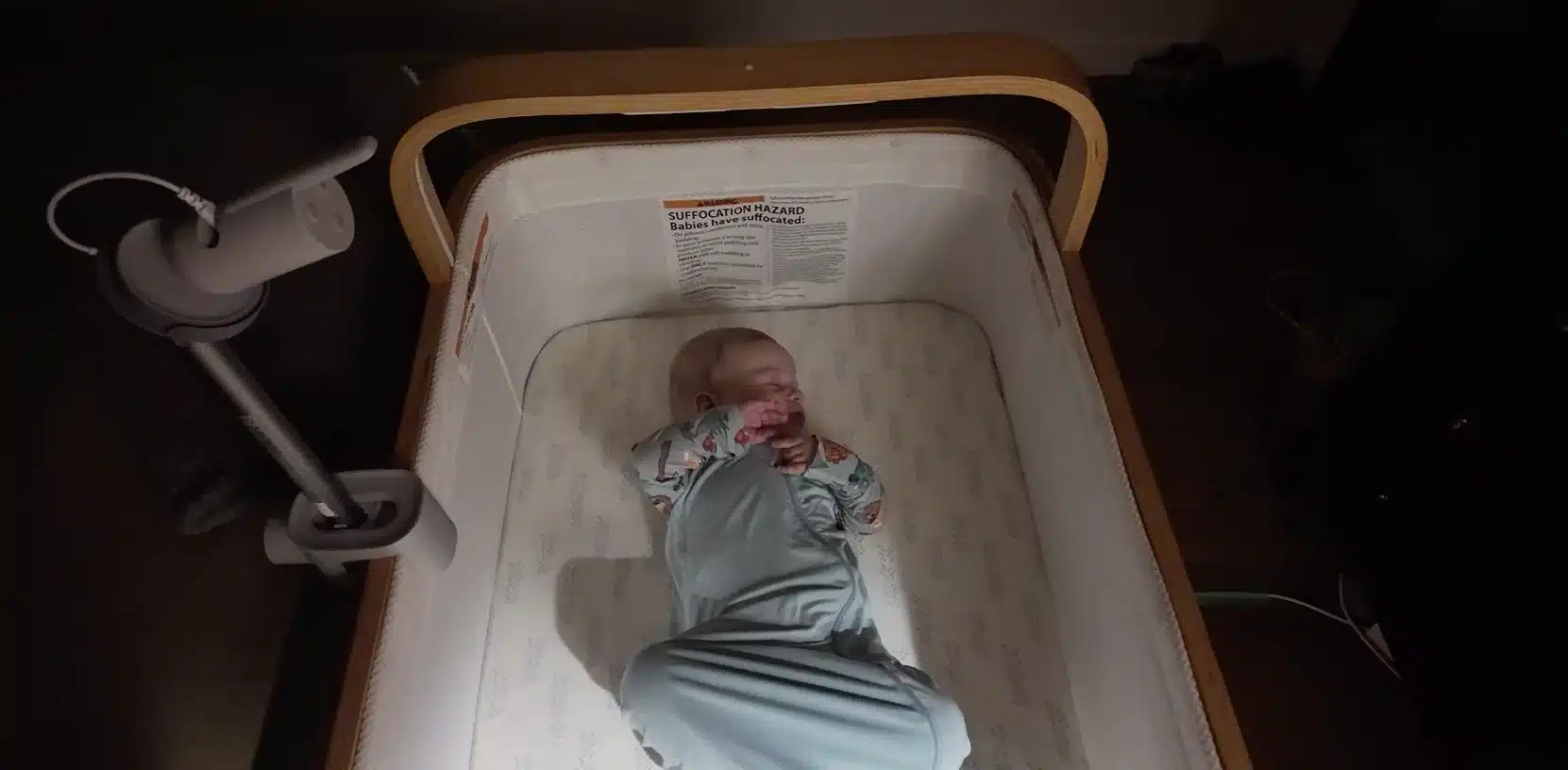
Philips told us that’s expected when the baby is still small: the breathing movements are so tiny that SenseIQ can’t detect them from too far away, and SenseIQ works at a greater distance as the baby grows. Philips’ setup guidance (Philips FAQ: “Can I use SenseIQ without the mount?”), as of October 2026: mount the camera at the center of the crib’s long side; use the crib mount while the mattress is at its highest position; switch to the wall mount once your baby starts standing and the mattress is lowered. Wall height is 43 inches for the 2-in-1 mount and 51 inches for the wall-only version.
EMF test results: middle of the pack
I test every monitor for EMF, and the Philips Avent lands in the middle of my comparison chart: the same neighborhood as the Eufy E21 and the VTech, and significantly above the Nanit. On my meter it read 6.5 mW/m² at 2 feet. You can see the full chart in the video above, at about 8:24.
I prefer to keep monitors farther away as a precaution. With this monitor, that’s a trade-off: at six feet, SenseIQ isn’t close enough to work. If you want the sleep data during the infant stage, use the recommended mounting setup, then move the camera back when you no longer need the tracking. The full method and every monitor’s reading are in our Wi-Fi baby monitor EMF guide.
Philips Avent vs. Nanit vs. Eufy E21 vs. Miku
Swipe sideways to compare →
| Monitor | Breathing / sleep data | Wearable needed? | Subscription for breathing or sleep data? | Parent unit without Wi-Fi? | Price (as of Oct 2026) | Pick it if |
|---|---|---|---|---|---|---|
| Philips Avent Premium Connected (SCD973/37) | Live breathing rate, sleep state, 90-min timeline, ~1-month diary | No | No (Cry Translation and Moments are paid add-ons) | Yes (5-inch unit; app over Wi-Fi) | $349.99 on Amazon (SCD973/37, with crib pole, as of Oct 24, 2026); wall-only SCD971/37 $298.38 on Amazon (as of Oct 24, 2026) | You want data and a simple monitor in one box |
| Nanit Pro | Deepest sleep analytics we’ve tested | No for the camera’s sleep data | Yes for the analytics; most tiers over $100/yr | App-first (check bundle) | From about $300 for the camera | You’ll use the data and don’t mind paying yearly |
| Eufy E21 | None | No | No | Yes (5-inch unit + app) | About $260 | You want the cleaner simple monitor |
| Miku | Breathing tracking via camera | No | Yes, about $10/mo | App only | Check price | You’re set on Miku’s app and accept the fee |
The Philips Avent Premium Connected is the only monitor in this table that tracks breathing without a wearable or a subscription and still includes a parent unit that works without Wi-Fi. The Eufy E21 costs about $260 but has no breathing or sleep data. The Nanit starts around $300 for the camera, and the analytics that make it worth it are a yearly subscription, with most tiers running over $100 a year. Miku tracks breathing without a wearable but charges about $10 a month. (Nanit review · Eufy review (E21 section) · Miku review · all picks in our best baby monitors)
Philips Avent specs (from Philips, as of October 2026)
| Spec | Philips Avent Premium Connected |
|---|---|
| Camera | 1080p HD |
| Parent unit | 5-inch HD screen |
| Connection | Parent unit connects directly to the camera without Wi-Fi; app over Wi-Fi; switches automatically |
| SenseIQ | Breathing rate, sleep state, sleep diary; no subscription required |
| Paid add-ons | Cry Translation (after a 3-month free trial); Moments video clips ($5.99/mo after a 7-day free trial; auto-renews) |
| Mount options | SCD973/37: 2-in-1 crib + wall mount · SCD971/37: wall mount only |
| Security | Philips “Secure Connect System” encryption |
| Medical device? | No. Philips says it isn’t intended to detect breathing interruptions |
Source: Philips SCD973/37 product page and Philips support FAQs, checked October 2026.
Is the Philips Avent baby monitor worth the price?
This is a solid monitor with a data layer on top. A good simple monitor like the Eufy E21 runs about $260: great picture, parent unit and app, no breathing or sleep data. A data-first monitor like the Nanit starts around $300 for the camera, plus a yearly subscription for the analytics.
The Philips Avent Premium Connected with the crib pole (SCD973/37) was $349.99 on Amazon as of October 24, 2026, and the wall-mount-only SCD971/37 was $298.38. Check the link for today’s price. At full price, it makes sense if you’ll actually use the breathing and sleep tracking alongside the parent unit. If all you want is a picture and sound, it may not be worth the extra.
Check price: Philips Avent Premium Connected Baby Monitor SCD973/37 (crib + wall mount) · Wall-mount version: Philips Avent Premium Connected Baby Monitor SCD971/37 (wall mount only)
Philips Avent Premium Connected FAQ
Does the Philips Avent Premium Connected need a subscription?
No, not for the breathing and sleep tracking. Philips told us the breathing rate, live sleep status, sleep schedule, and weekly and monthly sleep diary are included. Only Cry Translation (after a free 3-month trial) and Moments video clips ($5.99 a month after a free 7-day trial) cost extra, as of October 2026.
Will the Philips Avent monitor alert me if my baby stops breathing?
No. It’s a breathing tracker, not a breathing alarm. Philips says it is not a medical device and is not intended to detect breathing interruptions. The “SenseIQ signal cannot be detected” notification means the camera can’t get a reading, and Philips told us it is not a medical alarm.
How close does the camera need to be for SenseIQ to work?
In my testing, SenseIQ stopped working with the camera at 6 feet and 5 feet and worked at about 3 feet on the crib pole. Philips told us SenseIQ works at a greater distance as the baby grows. Philips recommends the crib mount while the mattress is at its highest setting, then the wall mount once your baby starts standing.
Does the Philips Avent Premium Connected work without Wi-Fi?
Yes. The parent unit connects directly to the camera without Wi-Fi, and the app works over Wi-Fi when you want to check from your phone. Philips says SenseIQ needs a one-time Wi-Fi connection during setup, then works with or without Wi-Fi (Philips FAQ).
Philips Avent vs. Nanit: which should I get?
Get the Nanit if you want the deepest sleep analytics and don’t mind a yearly subscription (most tiers run over $100 a year). Get the Philips Avent if you want a breathing rate and sleep states with no subscription, a sharper picture (I rate it 9/10), and a dedicated parent unit.
Philips Avent vs. Owlet Dream Sock: what’s the difference?
The Philips Avent tracks breathing rate and sleep state with a camera and nothing on the baby, and it doesn’t alarm. The Owlet Dream Sock is a sock sensor that monitors pulse rate and oxygen saturation and notifies you when readings go outside preset ranges. The FDA authorized the Dream Sock in 2023 as an over-the-counter monitor for healthy babies 1 to 18 months old; Owlet’s prescription BabySat is for babies with medical needs.
What’s the difference between the SCD973 and SCD971?
The mount. Philips sells the SCD973/37 with a 2-in-1 crib and wall mount and the SCD971/37 with a wall mount only. I tested the crib-pole version (SCD973/37).